
If you are in crisis right now, please reach out immediately.
Help is available 24 hours a day, 7 days a week.
Home
›
Blog
›
Rights of Suicide Survivors
Ronda Gallawa-Foyt, MA, LMHC
Licensed Mental Health Counselor · New Direction Counseling, Vancouver, WA
Ronda has over 25 years of clinical experience in individual counseling, trauma recovery, and grief support. She holds a Master’s in Counseling Psychology from Lewis and Clark College and a Biblical Counseling Certification through the American Board of Biblical Counselors. In this article, she shares a first-person perspective on suicide loss alongside her professional counseling experience.
✦ Key Takeaways
- Suicide loss is a distinct kind of grief — and no one else gets to dictate its shape, its timeline, or its language.
- The words you use to describe your loss — “died by suicide,” “killed himself,” “committed suicide” — are yours. All of them can be true at different moments.
- Grief after suicide is allowed to be contradictory: rage and love, devastation and relief, falling apart and getting up, sometimes all in the same day.
- Well-meaning people often go silent after a suicide loss — not because they don’t care, but because they don’t know what to say. Their silence is not a measure of your worth or your loss.
- Specialized suicide loss grief counseling Vancouver survivors trust offers a space where your whole story — exactly as it is — is welcome.
Rights of Suicide Survivors
A Personal Story of Suicide Loss
Twenty years ago, my father took his own life. Even now, the ripple of that single act is still moving through every part of me — and through everyone who loved him. It’s part of why I now offer suicide loss grief counseling Vancouver survivors can turn to, built from both clinical training and lived experience.In the beginning, the isolation was crushing. Indeed, we all loved the same man, but each of us lost a different version of him — a different father, a different friend. So we could hold each other while we cried, and yet somehow each of us still cried alone.Beyond our own circle, there were the people on the outside — friends, coworkers, distant relatives — who wanted to help but had no map for this territory. Instead, most simply went silent or changed the subject. Meanwhile, a few offered the standard “Let me know if there’s anything I can do” and then disappeared. Still, I don’t blame them, because most people have never stood this close to suicide. In other words, they’re terrified of saying the wrong thing, so they say nothing at all.
When Someone Else Tried to Own My Words
Years later, when I thought my own healing was far enough along that I might be useful to others, I reached out to a local suicide-bereavement organization to volunteer as a support-group facilitator. During the conversation I said, quite naturally: “My father killed himself, and I’d like to help others walking through suicide loss.”
However, the response was immediate and icy.
“We don’t say ‘killed himself’ or ‘committed suicide’ here. We say ‘died by suicide.’ Those other phrases are harmful and stigmatizing.”
Specifically, she went on to explain that my words implied criminality — that they demonized the person who died, and that they ignored the reality of mental illness. The call ended quickly after that. Apparently my language disqualified me from helping anyone.
As a result, I walked away stunned — and deeply angry.
💡
I understand the intention behind careful language. Words carry real weight, and the movement toward “died by suicide” reflects a genuine desire to reduce stigma. But something in me rebelled — and still does — at the idea that ten years into my own grief, someone else got to police how I speak about the worst day of my life.
All of It Is True — and All of It Is Yours
Some days I’m furious, and I think: “How could you kill yourself and leave me with this mess?”
Other days I’m heartbroken and whisper: “Dad, why did you do that to yourself?”
And then there are still other days when I simply say: “He died by suicide” — because that feels true and gentle and accurate in that moment.
All of it is true. Furthermore, all of it is mine.
If you have lost someone to suicide and you’ve come looking for Christian grief counseling in Vancouver or faith-based support after suicide loss, please hear this clearly:
Your Rights as a Suicide Loss Survivor
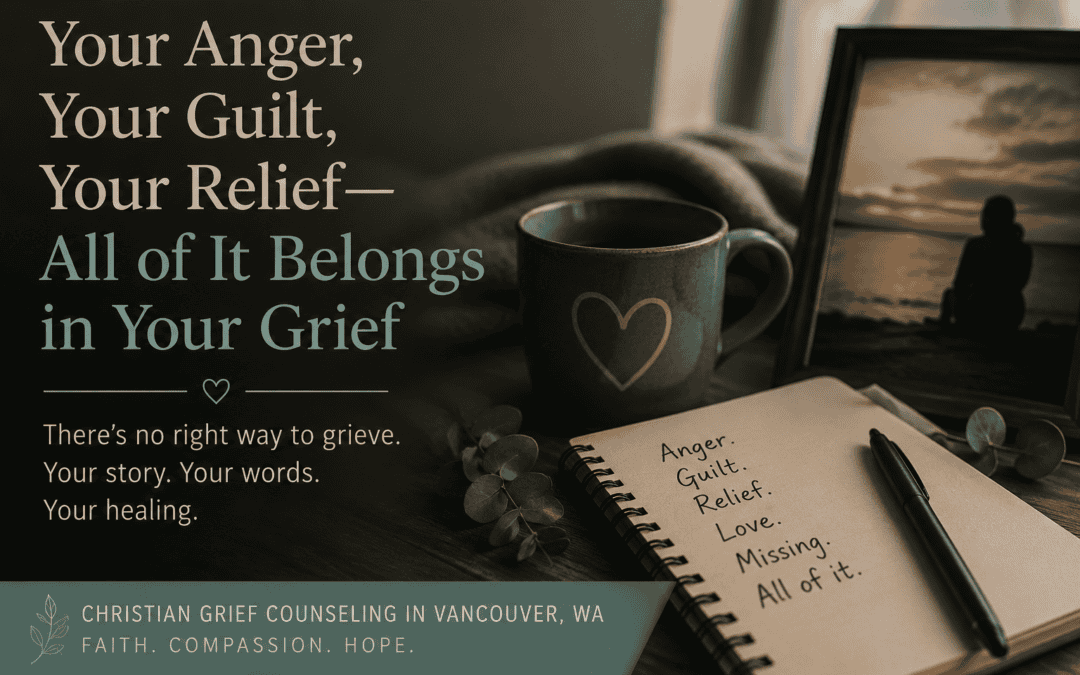
- This is your loss. Speaking about it is yours to do however feels right.
- These are your memories — and no one else gets to curate them for you.
- The words belong to you: your tears, your rage, your forgiveness, in whatever order they show up.
- Saying “he killed himself,” or “she committed suicide,” or “they died by suicide,” or simply “I lost them” — all of these are valid. So is saying nothing at all.
- Hating them one day and missing them unbearably the next? That is grief doing what grief does.
- Falling apart on the kitchen floor eating ice cream for dinner, getting up and going to work the next morning, or doing both in the same day — every version of that is allowed.
Consequently, no one — no support group, no facilitator, no well-meaning friend, no therapist — gets to dictate the shape of your grief.
Why Suicide Loss Feels So Isolating — Even Around People Who Care
The isolation of suicide loss is, in fact, one of its most under-discussed dimensions. It is possible to be surrounded by people who genuinely love you — who show up, who bring food, who hug you — and still feel completely alone in what you are carrying.
Part of that isolation is practical: most people around you haven’t experienced this kind of loss, so they genuinely don’t know what to say or do. Their silence isn’t cruelty — it’s fear. Specifically, fear of saying the wrong thing. Or, just as often, fear of making it worse. Underneath both is simply fear of the subject itself.
The Questions That Have No Clean Answers
Part of what makes this grief so isolating is something harder to name. Suicide loss often carries a weight of questions that other griefs don’t carry in the same way: Why didn’t I see it? Did they know I loved them? Was there something I missed? These questions don’t have clean answers, and they can’t be resolved by the usual comforts. And so the grief curls inward, carrying things it can’t fully speak.
The Stigma That Narrows Your Support
There is also the stigma that still, in 2026, surrounds suicide — making it harder to talk about openly, harder to grieve publicly, and harder to receive the same uncomplicated condolences that other losses receive. Organizations like the American Foundation for Suicide Prevention have done important work naming and reducing that stigma, but it hasn’t disappeared.
Understanding why this kind of grief is so isolating isn’t an academic exercise. Rather, it’s the first step toward finding the right kind of support — support that doesn’t need you to clean up your language or straighten out your emotions before you walk in the door.
“The Lord is close to the brokenhearted and saves those who are crushed in spirit.”
— Psalm 34:18 (NIV)
This is not a tidy Scripture. It doesn’t explain why, and it doesn’t promise the pain will end quickly. Instead, it says God is close — present in the crush, not distant from it. For those navigating suicide loss through a lens of faith, that kind of proximity matters more than the answers that aren’t coming yet.
Suicide Loss Grief Counseling Vancouver: What to Expect
Ultimately, my only job — if you trust me to walk with you for a while — is to sit in the dark with you. That means listening without flinching, holding space for every contradictory feeling, and helping carry the weight until it feels a little lighter. This is what suicide loss grief counseling Vancouver clients describe when they talk about finally being heard.
In practice, that means:
- You can use any words you need to describe what happened, and I won’t correct them.
- Being angry at the person who died is also allowed here. That anger belongs in this room as much as your love does.
- Questions without answers are welcome too, since we don’t have to resolve them to make progress.
- There’s no need to rush. Grief after suicide doesn’t follow a timetable, and I won’t ask you to perform healing faster than it’s actually happening.
- Your faith has a place here as well — your prayers, your doubts, your silence with God, your wrestling. All of it is welcome.
Therefore, whether that’s in individual sessions or, when you’re ready, in a small group of fellow survivors, the space will be yours — raw, real, and respected exactly as it is.
What Clients Say About Grief Support at New Direction Counseling
Below are words shared by individuals who have trusted this space with their grief. Names and identifying details have been changed to protect confidentiality.
I lost my son to suicide two years ago and couldn’t find anyone who understood the difference between this grief and other grief. From the first session, Ronda didn’t flinch. She didn’t rush me toward forgiveness or resolution. She just stayed. That was more than I’d gotten anywhere else.
Margaret T.
Suicide loss survivor · Vancouver, WA
I came in with so much guilt. The kind of guilt that doesn’t care what’s logical. Ronda never told me I shouldn’t feel it — she sat with it alongside me until it started to loosen. I didn’t expect that kind of patience. It changed things for me.
David R.
Surviving spouse · Clark County, WA
What I needed was someone who understood the spiritual dimension of this kind of loss — the anger at God, the silence in prayer, the questions that have no answers this side of eternity. Ronda held all of that with me. She brought her faith into the room without ever forcing it on mine. That mattered more than I can say.
Lynette P.
Faith-based grief support client · Vancouver, WA
I was furious at my brother for leaving us — and I was ashamed of being furious at someone who was suffering. Ronda helped me understand that both could be true at the same time. That it’s not a betrayal of love to be angry. I didn’t find that permission anywhere else.
Kevin A.
Sibling survivor · Portland metro area
* Names and identifying details changed to protect client confidentiality. Testimonials reflect individual experiences and are shared with permission.
Your Grief, Exactly as It Is, Belongs to You
If you’re looking for suicide loss grief counseling Vancouver families and individuals trust, and you want a place where your whole story — all of it, exactly as you need to tell it — is welcome, I’m here.
You don’t have to pretty it up, and the “right” words are not required here either.
Similarly, arriving with your grief in a presentable shape is not a condition of entry.
You just have to show up, however you are, and we’ll start from there.
You are not alone — and your grief, exactly as it is, belongs to you.
New Direction Counseling · Vancouver, WA
Ready to Begin? There Is No Wrong Way to Start.
Ronda Gallawa-Foyt, MA, LMHC offers compassionate, Christ-centered suicide loss grief counseling Vancouver families trust — for individuals and families, in person or via telehealth across Washington State.
Learn About Suicide Counseling Services →
Contact Us to Schedule a Session
If you are in crisis now: Call or text 988 · Call 911
3615 Grant Street, Vancouver, WA · 503-962-0945 · Telehealth available statewide
Crisis Resources — Available 24/7
- 988 Suicide and Crisis Lifeline — Call or text 988
- Crisis Text Line — Text HOME to 741741
- National Emergency — Call 911 or go to your nearest emergency room
- Clark County Crisis Line — 1-800-841-0202
- Veterans Crisis Line — Call 988 and press 1, or text 838255
Frequently Asked Questions
Is it my fault? Could I have stopped it?
This is the question that lives at the center of almost every survivor’s grief, and it deserves an honest answer rather than a quick reassurance. Suicide is the result of immense internal pain and, frequently, undiagnosed or undertreated mental illness. The factors that lead someone to that point are complex and largely invisible to the people who love them — even the most attentive, most devoted people in someone’s life. Still, guilt is almost universal among survivors. Processing it honestly in a counseling space — rather than either carrying it silently or being told too quickly to let it go — is one of the most important parts of grief work after suicide loss.
Is it normal to keep replaying the last conversation, the last day, looking for what I missed?
Yes, and it is one of the most exhausting parts of this grief. The mind searches for the moment where things could have changed, as if finding it would allow you to go back and fix it. This kind of circular thinking is a normal trauma response — and it tends to ease as the shock and most acute phases of grief begin to ease, often with professional support.
Do I have to use specific language about how my person died?
No. As this article describes from personal experience, the language of suicide loss belongs to the person carrying it. “Died by suicide,” “killed himself,” “committed suicide,” “took her own life” — these are all yours to use or not use, depending on what feels true in the moment. A grief counselor’s job is to meet you where you are, not to correct how you speak about the worst experience of your life.
How is grief after suicide different from other kinds of loss?
Grief after suicide often involves several layers that other losses do not carry in the same way: the trauma of the death itself, particularly if it was sudden or violent; guilt and self-blame; unanswerable questions; stigma from others that can narrow your support network; and the complicated emotional mix of loving someone and being devastated by a choice they made. Together, these layers make suicide bereavement a distinct kind of grief that benefits from specialized support rather than general bereavement counseling.
What if I feel relieved — does that make me a terrible person?
It does not. Relief is more common in suicide grief than most people admit, particularly when the person who died had been suffering visibly for a long time, or when their behavior had become frightening or destructive. That relief does not mean you wanted them to die, and it does not erase your love either. Rather, it is a human response to an impossibly complicated situation, and it deserves the same compassionate space as every other emotion in your grief.
Will I ever stop feeling this way?
The grief does not disappear, but it does change. Most survivors describe a gradual shift — not from pain to no pain, but from pain that floods everything to pain that can be held alongside other things. In other words, the loss remains part of you, yet it becomes possible to carry it without it consuming every hour. That shift usually happens through time, connection, and — for many people — the sustained support of a skilled grief counselor.
Can Christian counseling help with suicide loss?
For many people of faith, the spiritual dimensions of suicide loss are among the most painful and the most unsupported. Questions about God’s presence in the suffering, about what happens to those who die by suicide, about how to pray when prayer feels hollow — these deserve to be brought into the counseling space, not set aside. Christian grief counseling in Vancouver, WA at New Direction Counseling holds space for all of it — faith, doubt, silence, and wrestling — alongside clinical evidence-based care.
When should I seek professional grief counseling after a suicide loss?
There is no waiting period required. You can reach out immediately after a loss if you feel you need support, or, alternatively, months or years later when the grief resurfaces in a new way. Many survivors wait far too long because they feel they “should” be managing it on their own by now. There is no “should.” If the grief is affecting your daily life, your relationships, your physical health, or your own sense of safety, reaching out to a counselor is the right step — whenever that moment arrives for you.
Is telehealth grief counseling available for suicide survivors outside Vancouver?
Yes. New Direction Counseling offers telehealth grief counseling for clients anywhere in Washington State. If you are outside the Vancouver, WA area and looking for specialized suicide bereavement support, online sessions provide the same quality of care as in-person work — in a private, accessible format.
Related at New Direction Counseling
- Suicide Loss Grief Counseling Vancouver — In-person and telehealth support for survivors of loss and those experiencing suicidal thoughts.
- Grief Counseling in Vancouver, WA — Compassionate support for all forms of loss and bereavement.
- Individual Counseling — One-on-one support for depression, grief, trauma, and life crises.
- EMDR Therapy Vancouver — For processing the trauma dimensions of suicide loss.
- Distance Counseling — Telehealth grief counseling for clients anywhere in Washington State.

Recent Comments