
✦ Key Takeaways
- Relationship red flags are rarely dramatic at first — they tend to be quiet, repeated patterns that get explained away or minimized.
- A single difficult moment is different from an established pattern. Context and repetition matter.
- The most overlooked red flags include inconsistency, subtle control, contempt, and a lack of accountability — not just obvious dishonesty or cruelty.
- Many red flags are workable with awareness, honest conversation, and professional support — but only if both partners are willing to acknowledge the pattern.
- Couples counseling provides a structured, neutral space to name red flags directly and determine whether — and how — a relationship can move forward in a healthier direction.
Looking back, almost everyone can point to a moment in a past relationship and say: I should have noticed that sooner. Not because the signs weren’t there — but because they were easy to explain away. A controlling comment got chalked up to “they just care a lot.” A pattern of broken promises got excused as “they’re just busy.” A flash of contempt got dismissed as “everyone has a bad day.”
This is exactly how relationship red flags work. They rarely announce themselves clearly. They show up quietly, repeatedly, and are almost always easier to minimize than to confront. Learning to recognize them — not with suspicion, but with clarity — is one of the most valuable relational skills you can develop, whether you’re dating, newly committed, or years into a long-term partnership.
Below are the 10 relationship red flags that come up most often in clinical practice — the ones people wish, in hindsight, they had taken seriously sooner. And if you recognize several of these in your own relationship, know this: many of these patterns are workable, especially with the right support through couples counseling in Vancouver, WA.
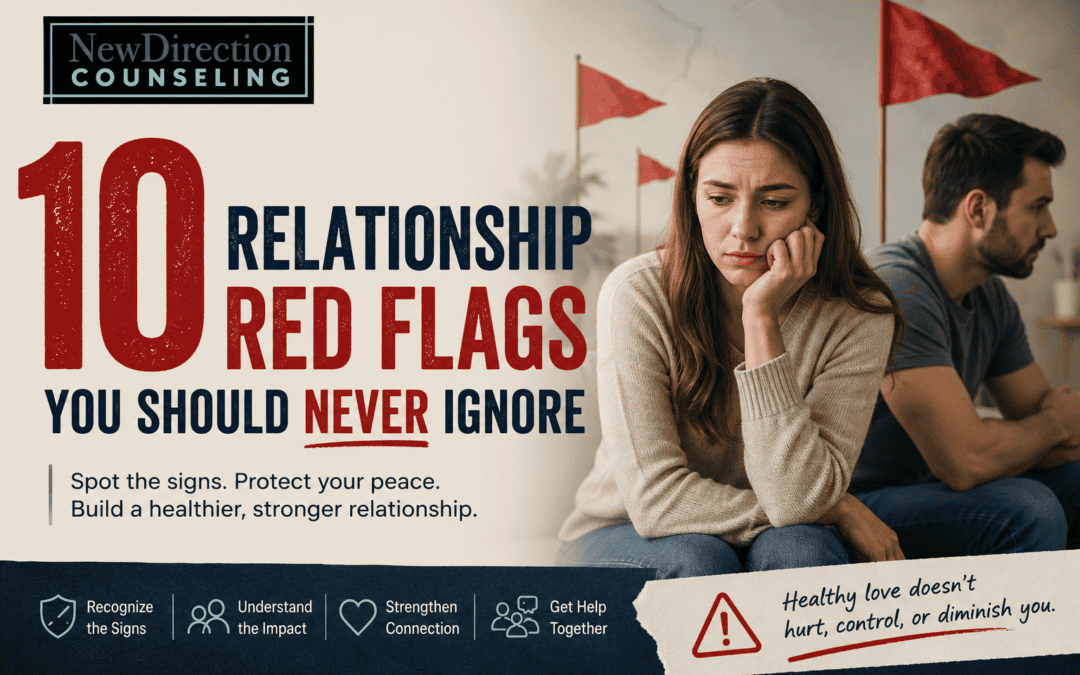
10 Relationship Red Flags You Should Never Ignore
1. A Pattern of Control Disguised as Care
Tracking your location “out of concern.” Discouraging time with friends “because they’re not good for you.” Making major decisions on your behalf without real conversation. Genuine care respects your autonomy; control disguises itself as care while quietly limiting your freedom.
Why it matters: Controlling behavior tends to escalate gradually. What feels like attentiveness early on can become restriction and isolation over time if left unaddressed.
2. Inconsistency Between Words and Actions
Promises that rarely match follow-through. Apologies that aren’t accompanied by changed behavior. A pattern where what your partner says and what they actually do consistently diverge.
Why it matters: Trust is built on reliability, not eloquence. A relationship where words consistently outpace actions erodes trust slowly, even without a single dramatic incident.
3. Contempt — Sarcasm, Mockery, or Eye-Rolling
Relationship researcher Dr. John Gottman identified contempt as the single strongest predictor of relationship breakdown. It shows up as sarcasm, mockery, eye-rolling, or a tone that communicates “you are beneath me” — even in seemingly minor exchanges.
Why it matters: Contempt signals a breakdown in basic respect. Unlike frustration or disagreement, which are normal, contempt actively communicates disdain — and it is corrosive to long-term connection.
4. Difficulty Taking Accountability
Every conflict somehow becomes your fault. Apologies are rare, conditional, or followed immediately by a counter-accusation. A consistent inability to say “I was wrong” or “I’m sorry, that hurt you” without deflecting.
Why it matters: Accountability is the foundation of repair. Without it, conflicts never actually resolve — they just repeat in slightly different forms.
5. Isolation From Friends, Family, or Support Systems
Subtle (or not-so-subtle) discouragement from spending time with people who matter to you. Growing distance from friendships and family relationships that existed before the relationship began.
Why it matters: A healthy relationship adds to your life without subtracting your other meaningful connections. Isolation — even when framed as wanting more time together — often reflects a deeper need for control.
6. Dishonesty, Even About Small Things
Small lies about where they were, who they were with, or what they spent. The reasoning “it wasn’t a big deal” used repeatedly to excuse dishonesty.
Why it matters: Patterns of small dishonesty are rarely isolated — they tend to reflect a broader comfort with deception that often surfaces in larger ways over time.
7. Disrespect of Stated Boundaries
You’ve clearly communicated a boundary — about time, physical affection, finances, or personal space — and it gets tested, pushed, or ignored repeatedly, sometimes followed by guilt-tripping when you reassert it.
Why it matters: A partner who consistently respects your boundaries, even when inconvenient for them, demonstrates genuine regard for you as a separate person. Repeated boundary violations signal the opposite.
8. Explosive or Unpredictable Reactions
Disproportionate anger over minor issues. A pattern of walking on eggshells, trying to anticipate and avoid whatever might trigger an outburst.
Why it matters: Emotional unpredictability creates chronic low-level anxiety in a relationship. Safety — feeling like you can be yourself without bracing for a reaction — is foundational to genuine intimacy.
9. Unwillingness to Grow or Reflect
A flat refusal to consider feedback. Treating any request for change as a personal attack. A pattern of “this is just who I am” used to shut down growth-oriented conversations.
Why it matters: All relationships require both people to grow and adjust over time. A consistent refusal to reflect or change, even on small things, often signals that larger issues will be similarly resistant to resolution.
10. Feeling Smaller, Not Bigger, Around Your Partner
This is perhaps the most important — and most overlooked — red flag of all. A healthy relationship should generally leave you feeling more like yourself, more confident, more secure. If you consistently feel smaller, more anxious, less sure of yourself, or like you’re constantly editing who you are to keep the peace, that feeling deserves serious attention.
Why it matters: This is often the clearest internal signal a person has — even before they can articulate exactly which specific behaviors are causing it.
predictor of relationship breakdown: contempt (Gottman Institute research)
accuracy in predicting divorce from observing the “Four Horsemen” patterns
average time couples wait before seeking professional help for relationship issues
Red Flag or Normal Relationship Friction? How to Tell the Difference
Not every difficult moment is a red flag. Every relationship involves friction, disagreement, and imperfect days. The key distinctions that separate a genuine red flag from ordinary friction:
| Factor | Normal Friction | Genuine Red Flag |
|---|---|---|
| Frequency | Occasional, situational | Repeated, established pattern |
| Response to Feedback | Partner listens and adjusts | Defensiveness, denial, or no change |
| Impact on Safety | You still feel secure overall | You feel anxious, smaller, or unsafe |
| Trajectory | Improves with communication | Stays the same or worsens over time |
What to Do If You Recognize These Red Flags
Name What You’re Noticing — Even Just to Yourself
Write down the specific pattern you’ve observed, with concrete examples. This clarity makes it much harder to talk yourself out of what you’ve seen.
Bring It Up Calmly and Specifically
Use concrete examples rather than generalizations: “When you canceled plans with my sister three times in a row, I started to feel like our relationship was being prioritized over everything else in my life.”
Watch the Response, Not Just the Apology
Does your partner get curious and reflective, or defensive and dismissive? The quality of their response often matters more than the words of the apology itself.
Give It Time — But Watch for Real Change, Not Just Promises
Genuine change takes consistent effort over weeks and months, not a single good week. Watch behavior, not just words, over a meaningful period of time.
Seek Professional Support
Couples counseling provides a neutral, structured space to address red flags directly — with a trained professional helping both partners see the pattern clearly and determine a healthy path forward.
Common Mistakes People Make When Facing Relationship Red Flags
Mistake #1: Minimizing the Pattern
“It’s not that bad,” “they didn’t mean it that way,” or “I’m probably overreacting” are common ways people talk themselves out of trusting what they’ve observed. Repeated minimization is itself a pattern worth examining.
Mistake #2: Confusing Intensity With Intimacy
Dramatic highs and lows can feel passionate, but intensity is not the same as health. Some of the most stable, secure relationships involve far less drama than people expect.
Mistake #3: Waiting for the Red Flag to Resolve Itself
Patterns rarely improve without direct conversation and, often, professional support. Hoping a behavior will simply fade over time is usually a passive strategy that allows the pattern to deepen.
Mistake #4: Only Addressing the Surface Behavior
Focusing only on the specific incident (“you canceled on me again”) without naming the underlying pattern (“I’m noticing a pattern where commitments to me seem to come last”) often leads to repeated, surface-level conversations that never produce lasting change.
Mistake #5: Going It Alone Without Support
Working through red flag patterns without outside perspective — whether from a trusted friend, mentor, or licensed therapist — makes it significantly harder to see clearly and stay grounded in your own judgment.
How Couples Counseling Helps Address Relationship Red Flags
Recognizing a red flag is the first step. Addressing it well — without either ignoring it or reacting impulsively — is where many couples benefit most from professional support.
Couples counseling at New Direction Counseling in Vancouver, WA offers:
- A neutral space where both partners can name concerns without the conversation immediately escalating into conflict
- Pattern identification — helping both people see the specific dynamic at play, often more clearly than either could see alone
- An honest assessment of whether a pattern reflects something workable, like a communication gap or unhealed wound, versus something more serious requiring a different response
- Accountability tools for the partner whose behavior needs to change, paired with support for the partner who has been affected by the pattern
- A faith-integrated option for couples who want their relationship work grounded in biblical principles of mutual respect, honesty, and covenant commitment
“Plans fail for lack of counsel, but with many advisers they succeed.”
— Proverbs 15:22 (NIV)
Seeking outside wisdom isn’t a sign that a relationship has failed — it’s a sign that both people are taking the relationship seriously enough to want it to succeed.
Frequently Asked Questions
Is it normal to see some red flags early in a relationship?
Occasional friction or imperfection is normal in any relationship. What distinguishes a true red flag is a repeated pattern — especially one involving control, disrespect, or dishonesty — that does not improve despite being addressed. A single difficult moment is different from an established pattern.
Can a relationship survive after red flags are identified?
Yes, in many cases. Identifying a red flag early, naming it directly, and working with a couples counselor can lead to meaningful change, especially when both partners are willing to take responsibility and grow. However, red flags involving abuse, repeated dishonesty, or unwillingness to change are more serious and may require a different response.
What is the difference between a red flag and a personality difference?
A personality difference might involve different communication styles, hobbies, or social preferences that don’t compromise safety, respect, or trust. A red flag involves behavior that erodes safety, respect, autonomy, or honesty in the relationship over time.
How do I bring up a red flag with my partner?
Approach the conversation calmly and specifically, using concrete examples rather than generalizations. Focus on how the behavior affects you rather than attacking your partner’s character, and pay close attention to how they respond — defensiveness and dismissal are themselves significant data points.
When should a couple seek professional counseling for red flags?
Couples should consider professional counseling when a red flag pattern persists despite direct conversation, when trust has been broken, when communication repeatedly breaks down, or when one or both partners feel unsafe, unheard, or stuck in a repeating cycle of conflict.
Are red flags always a reason to end a relationship?
Not necessarily. Many red flags reflect unhealed wounds, learned patterns, or skill gaps that can improve significantly with awareness and professional support. The critical factor is whether both partners are willing to acknowledge the pattern and do the work to change it.
Conclusion: Trust What You’re Noticing
Recognizing a relationship red flag isn’t about becoming hypervigilant or suspicious of every imperfect moment. It’s about learning to trust the patterns you actually observe, rather than the explanations you talk yourself into. Most people who look back on a difficult relationship can point to the early signs — and most also remember the very real pressure to dismiss what they were noticing.
If you recognize several of these patterns in your own relationship, that recognition is valuable information, not an overreaction. Many of these dynamics are genuinely workable — especially when both partners are willing to engage honestly and seek support. Couples counseling offers exactly that: a space to name what’s happening clearly, understand it more deeply, and decide together what healthy change actually looks like.
You deserve a relationship where you feel more like yourself, not less. That clarity is worth protecting.
New Direction Counseling · Vancouver, WA
Noticed a Red Flag? Let’s Talk It Through Together.
Ronda Gallawa-Foyt, MA, LMHC offers compassionate, Christ-centered couples counseling in Vancouver, WA — helping partners name hard patterns honestly and build something healthier together.
Book a Couples Counseling Session →
In-person at 3615 Grant Street, Vancouver, WA · Telehealth available statewide · 503-962-0945
Related Services at New Direction Counseling
- Couples Counseling in Vancouver, WA — Structured, compassionate support for navigating red flags and rebuilding trust.
- Individual Counseling — One-on-one support for processing what you’re noticing and rebuilding your own clarity and confidence.
- EMDR Therapy Vancouver — Trauma-focused therapy for patterns rooted in past relational wounds.
- Distance Counseling — Telehealth couples counseling accessible from anywhere in Washington State.
- About Ronda — Meet your counselor — 25+ years of clinical experience with a faith-centered approach.

Recent Comments