
Ronda Gallawa-Foyt, MA, LMHC
Licensed Mental Health Counselor · New Direction Counseling, Vancouver, WA
Ronda has over 25 years of clinical experience and holds a Master’s in Counseling Psychology from Lewis and Clark College, as well as a Biblical Counseling Certification through the American Board of Biblical Counselors — combining clinical expertise with deep biblical grounding in every session.
✦ Key Takeaways
- Christian counseling benefits go beyond talk therapy — it integrates Scripture, prayer, and clinical psychology to address the whole person: mind, body, and spirit.
- Common signs you may need Christian counseling include persistent anxiety, spiritual doubt, unresolved grief, relationship conflict, and feeling disconnected from God.
- Biblical counseling isn’t a replacement for licensed therapy — the best Christian therapists are trained clinicians and grounded in Scripture.
- Christian counseling is effective for individuals, couples, families, and teens facing anxiety, depression, trauma, addiction, and grief.
- Choosing a licensed, credentialed Christian counselor — not just someone who “identifies as Christian” — matters for real, lasting change.
Life has a way of pressing on every seam we have — our marriages, our faith, our sense of self, our peace of mind. When the pressure builds long enough, many people quietly wonder: “Is this something I should just pray through, or do I need real help?”
If you’ve asked yourself that question, you’re not alone — and you’re not weak for asking it. Understanding the Christian counseling benefits available to you can be the turning point between white-knuckling through pain and actually healing from it. Christian counseling blends licensed clinical expertise with biblical truth, offering a path forward that honors both your mental health and your faith. In this guide, we’ll walk through ten clear signs that Christian counseling might be right for you, what makes it different from secular therapy, and how to know if a Christian therapist is the right fit for your season of life.
What Is Christian Counseling, Really?
Christian counseling is professional mental health treatment that integrates faith, Scripture, and prayer with clinical psychological methods. Unlike purely secular therapy, a Christian therapist views a person’s struggles through both a clinical lens and a spiritual one — recognizing that emotional wounds often carry spiritual weight, and that spiritual wounds frequently show up as anxiety, depression, or broken relationships.
This is meaningfully different from simply talking to your pastor or a well-meaning friend. A qualified Christian counselor typically holds:
- A graduate degree in counseling, psychology, or a related clinical field
- State licensure — such as LMHC, LPC, or LCSW
- Additional biblical counseling training or certification (for example, through the American Board of Biblical Counselors)
That combination matters. It means you receive evidence-based clinical care — the same techniques used in trauma-informed therapy, EMDR, and cognitive behavioral therapy — layered with biblical wisdom and prayer, rather than one at the expense of the other.
Christian Counseling vs. Biblical Counseling vs. Secular Therapy
People often use these terms interchangeably, but there are meaningful differences worth understanding before choosing a provider.
| Approach | Clinical Training | Faith Integration | Best For |
|---|---|---|---|
| Secular Therapy | Licensed clinician | None or minimal | Clients who prefer a strictly clinical approach |
| Biblical Counseling | Varies widely; sometimes lay counselors | Scripture-centered; often church-based | Believers wanting a faith-first, church-connected approach |
| Christian Counseling | Licensed clinician plus biblical training | Integrated — clinical methods framed by faith | Believers wanting both clinical rigor and spiritual depth |
A skilled Christian therapist doesn’t choose between the couch and the Cross — they use both, holding your clinical needs and your spiritual life in the same room.
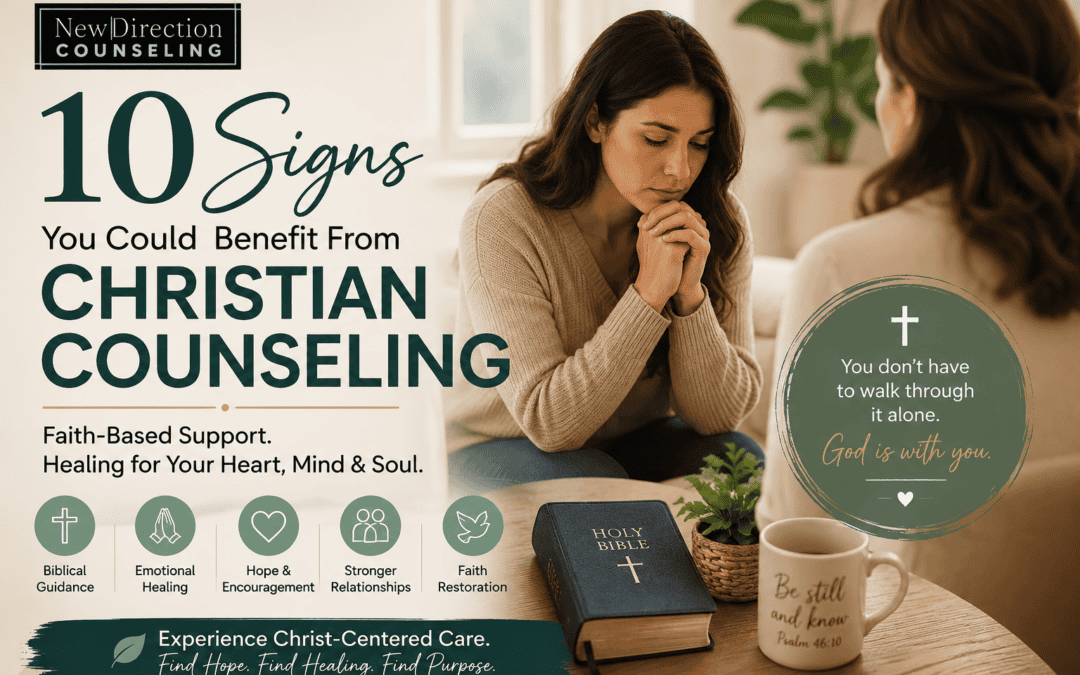
10 Signs You Could Benefit From Christian Counseling
Here are the most common signs that it may be time to reach out to a Christian counselor. You don’t need to identify with all ten — even two or three, if they’ve been persistent, are worth taking seriously.
1. You Feel Spiritually Distant From God
If prayer feels hollow, Scripture feels flat, or you find yourself asking “Where is God in all of this?” — that spiritual numbness is often a sign of unprocessed pain, not a lack of faith. A Christian counselor can help you work through the emotional blockage standing between you and a sense of God’s presence, addressing both what’s happening clinically and what’s happening spiritually at the same time.
2. You’re Struggling With Anxiety or Depression
Anxiety and depression don’t disappear because you’re a person of faith — and needing help for them isn’t a failure of faith either. Individual counseling in Vancouver for anxiety and depression combines clinical tools like cognitive behavioral therapy with biblical truth about identity, worth, and hope — addressing both the chemistry and the theology of despair.
3. You’re Grieving a Loss That Feels Unbearable
Whether it’s the death of a loved one, a devastating diagnosis, or a loss to suicide, grief can shake your faith to its core. Christian grief counseling gives you space to lament honestly — even to be angry with God — while walking you toward hope rather than around your pain.
4. Your Marriage or Relationship Feels Stuck
If you and your partner keep having the same conflict, feel more like roommates than a couple, or are considering separation, Christian marriage counseling can help. A faith-based approach addresses communication and conflict resolution while also restoring the covenantal, spiritual foundation of the relationship.
5. You’re Battling a Habit or Addiction You Can’t Shake
Whether it’s substance use, pornography, gossip, or other compulsive patterns, addiction often carries deep shame — and shame keeps people silent. A non-judgmental Christian counselor helps you address the root causes of addiction without fear of condemnation, replacing shame with grace-filled accountability.
6. You’ve Experienced Trauma or Abuse
Survivors of trauma — including sexual abuse, assault, or other deeply painful experiences — often need trauma-informed care that also makes room for spiritual questions like “Why did God allow this?” Techniques like EMDR therapy for trauma, delivered by a Christian therapist, can process traumatic memories while integrating faith-based healing.
7. You Feel Isolated, Even in a Room Full of People
Loneliness isn’t always about being physically alone. Many people feel isolated even within a church community, a marriage, or a close friend group. Christian counseling helps you understand the roots of that disconnection and rebuild authentic, vulnerable relationships grounded in both psychological health and biblical community.
8. Your Teen or Young Adult Is Struggling
Anxiety, identity questions, social pressure, and faith doubts hit teenagers especially hard. Christian counseling for teens gives young people a safe, non-judgmental space to process these struggles with a counselor who understands both adolescent psychology and biblical truth.
9. You’ve Tried Therapy Before, But It Didn’t “Reach” the Real Issue
If you’ve sat through secular therapy — or even Christian counseling that felt secular in disguise — and left feeling like something was still missing, that’s a common and valid experience. The deepest issues often have a spiritual root that purely clinical approaches can’t fully address. Christian counseling offers a more integrated path that may reach what previous therapy missed.
10. You Feel Stuck Between “Just Pray About It” and “Just See a Therapist”
Many believers feel caught between two extremes: well-meaning Christians who minimize mental health struggles with “just pray more,” and secular voices who dismiss faith as irrelevant to healing. Christian counseling offers a third way — one that takes both your mental health and your faith seriously, at the same time.
U.S. adults experiences a diagnosable mental health condition each year (NIMH)
average delay between symptom onset and seeking professional mental health support
“In the multitude of counselors there is safety” — seeking help is wisdom, not weakness
The Real Christian Counseling Benefits: What to Expect
Understanding the full range of Christian counseling benefits can help you decide if this path is right for your season of life.
Whole-Person Healing
Addresses emotional, relational, psychological, and spiritual dimensions together — not in isolation from one another.
A Safe Place for Doubt and Lament
You don’t have to pretend your faith is unshaken to get help. All of it — including anger at God — is welcome.
Clinically Sound Methods
Reputable Christian counselors use evidence-based approaches like CBT, EMDR, and trauma-informed care — not instead of Scripture, but alongside it.
Freedom From Shame
Grace-centered counseling makes it safer to be honest about addiction, failure, and sin without fear of judgment or condemnation.
Restored Perspective
Biblical truth reframes suffering with hope, meaning, and purpose — not bypassing the pain, but giving it context.
Stronger Relationships
Faith-integrated marriage and family counseling rebuilds trust on a spiritual as well as relational foundation.
Support During Life Transitions
Grief, divorce, career loss, and other major changes are processed with both clinical skill and spiritual grounding.
“In the multitude of counselors there is safety.”
— Proverbs 11:14 (KJV)
Common Mistakes and Misconceptions About Christian Counseling
Mistake #1: Assuming Any “Christian” Counselor Is Qualified
Not every counselor who mentions faith is clinically licensed or biblically trained. Ask about credentials directly before committing to a therapist — specifically whether they hold a state license (such as LMHC, LPC, or LCSW) and any additional biblical counseling certification.
Mistake #2: Believing Counseling Means Your Faith Isn’t Strong Enough
Seeking help is not a sign of spiritual weakness — it is wisdom. Proverbs 11:14 reminds us that “in the multitude of counselors there is safety.” Furthermore, many of Scripture’s most faithful figures — Job, David, Elijah, Paul — experienced profound emotional and psychological struggle without it reflecting a failure of faith.
Mistake #3: Expecting Instant Resolution
Real healing — especially from trauma, grief, or long-standing patterns — takes time. Consequently, be cautious of any approach promising a quick fix. Meaningful change is possible, but it typically unfolds over months, not days.
Mistake #4: Thinking Christian Counseling Ignores Clinical Science
The best Christian counselors don’t reject psychology — they integrate it. Faith and clinical expertise are not in competition. In fact, many of the most effective therapeutic methods — EMDR, CBT, attachment-based therapy — align naturally with a biblical understanding of how human beings are made and how they heal.
Mistake #5: Avoiding Counseling Because of Stigma
Many people delay seeking help for years due to fear of judgment from their church community or family. However, confidential, licensed Christian counseling is a private, safe space — and what you share there stays there.
Expert Tips for Choosing the Right Christian Therapist
Check licensure first
Look for credentials like LMHC, LPC, LCSW, or a similar state license — this ensures clinical accountability and professional standards.
Ask about biblical counseling training
Certifications through organizations such as the American Board of Biblical Counselors demonstrate intentional integration of faith and clinical work.
Clarify their approach to your specific concern
If you need trauma therapy, specifically ask if they are trained in EMDR or trauma-informed care. Generalist credentials don’t always mean specialized expertise.
Ask if they work with both faith-based and secular clients
A counselor experienced with diverse clients often has a broader clinical toolkit — and a more nuanced, non-preachy approach to integrating faith.
Consider telehealth if location is a barrier
Many Christian counselors now offer online Christian counseling across Washington State, expanding access well beyond your zip code.
Trust your gut in the first session
You should feel safe, respected, and neither judged nor coddled. If the fit doesn’t feel right, it’s always appropriate to look elsewhere — finding the right therapist matters more than staying with the first one you try.
What to Expect in Your First Christian Counseling Session
Many people delay booking an appointment partly because they’re uncertain about what the first session will involve. Here is a clear picture of what to expect so that first step feels less daunting.
Initial consultation and intake
You’ll discuss your history, current struggles, and goals for counseling. You share only what you’re comfortable sharing — there is no pressure to disclose everything in the first session.
Faith and values conversation
A good Christian counselor will ask how you’d like faith integrated into your sessions — and will never impose a spiritual framework you haven’t invited.
Collaborative goal-setting
Together, you’ll define what healing or progress looks like for you — because your goals shape the work, not a predetermined program.
Ongoing sessions
Typically weekly or biweekly, combining clinical techniques with prayer, Scripture, and spiritual reflection as appropriate to your needs and preferences.
Ongoing reassessment
A skilled counselor regularly checks in on progress and adjusts the approach as your situation evolves — so the work stays relevant and effective over time.
💡
Want to know more before your first appointment? Read about frequently asked questions about counseling — including what to expect, how sessions work, and what the costs look like.
Frequently Asked Questions
Is Christian counseling only for people with a strong faith?
No. Christian counseling welcomes people at every stage of faith — including doubt, distance from God, or serious questions about belief. Many Christian counselors also work with secular clients who simply want to work with a value-aligned therapist.
What is the difference between Christian counseling and biblical counseling?
Biblical counseling typically centers on Scripture through church-based or lay counselors. Christian counseling combines that biblical foundation with licensed clinical training — such as a state-recognized therapy license — offering both spiritual depth and clinical rigor.
Can Christian counseling help with anxiety and depression?
Yes. Christian counselors use clinically proven methods like cognitive behavioral therapy alongside biblical truth about identity, worth, and hope to treat anxiety and depression — addressing both the psychological and spiritual dimensions of these conditions.
Do Christian therapists treat trauma?
Many Christian therapists are trained in trauma-informed methods, including EMDR, to help survivors of abuse, assault, or traumatic loss process their experiences while integrating faith-based healing.
Is Christian marriage counseling different from regular couples therapy?
Christian marriage counseling addresses the same communication and conflict issues as secular couples therapy, but also works to restore the spiritual and covenantal foundation of the relationship — making it a more complete approach for couples of faith.
How do I know if a Christian counselor is properly licensed?
Ask directly about their state license (such as LMHC, LPC, or LCSW) and any additional biblical counseling certifications. A qualified counselor will share this information openly and without hesitation.
Can I do Christian counseling online?
Yes. New Direction Counseling offers online Christian counseling across Washington State via secure telehealth, providing the same quality of care as in-person sessions.
What if I have tried therapy before and it did not help?
That is a common and valid experience. Often, previous therapy did not address the spiritual root of the struggle. Christian counseling offers a more integrated approach — one that may reach what other therapy missed by addressing both the clinical and spiritual dimensions of your experience.
How long does Christian counseling typically take?
This varies by individual and issue. Some concerns improve meaningfully in a few months, while deeper trauma or long-standing patterns may take longer. Your counselor should reassess progress with you regularly so the work stays relevant and on track.
You Don’t Have to Choose Between Prayer and Professional Help
If you recognized yourself in even a few of these ten signs, that’s not a coincidence — it’s an invitation. The Christian counseling benefits we’ve walked through here — whole-person healing, biblical hope, clinical expertise, and a safe place to be fully honest — exist precisely for moments like this.
You don’t have to choose between “just praying about it” and “just seeing a therapist.” Furthermore, you don’t have to keep white-knuckling through pain that has real, available solutions. You can have both faith and clinical care working together for your healing.
Healing doesn’t require you to have it all figured out. It just requires a first step.
New Direction Counseling · Vancouver, WA
Ready to Take the Next Step?
If you’re in Vancouver, WA — or anywhere in Washington State via telehealth — Christian Counseling with New Direction Counseling offers biblically grounded, trauma-informed care from a licensed, credentialed Christian therapist.
3615 Grant Street, Vancouver, WA · 503-962-0945 · Telehealth available statewide
Related Services at New Direction Counseling
- Christian Counseling — Biblically grounded, clinically sound support for the whole person.
- Individual Counseling in Vancouver — Personalized support for anxiety, depression, grief, trauma, and life transitions.
- Christian Marriage Counseling — Faith-integrated couples support for communication, conflict, and reconnection.
- Christian Grief Counseling — Compassionate support for loss, lament, and the spiritual questions grief raises.
- Suicide Bereavement Support — Specialized care for those navigating loss to suicide.
- EMDR Therapy for Trauma — Trauma-focused therapy integrated with a faith-based framework.
- Online Christian Counseling Across Washington State — Telehealth sessions from anywhere in WA.
- More About Ronda’s Approach to Counseling — Meet your therapist and understand her clinical and biblical credentials.

Recent Comments